> For the complete documentation index, see [llms.txt](https://docs.plenit.com/llms.txt). Markdown versions of documentation pages are available by appending `.md` to page URLs; this page is available as [Markdown](https://docs.plenit.com/docs-en/productos/object-storage/concepts/resilience-and-security.md).
# Resilience and security
Triple replication, off-site copy, encryption, and compliance that protect your data.
Durability and security are built into the service design; they are not an add-on you configure.
This is what protects what you store.
### Triple replication
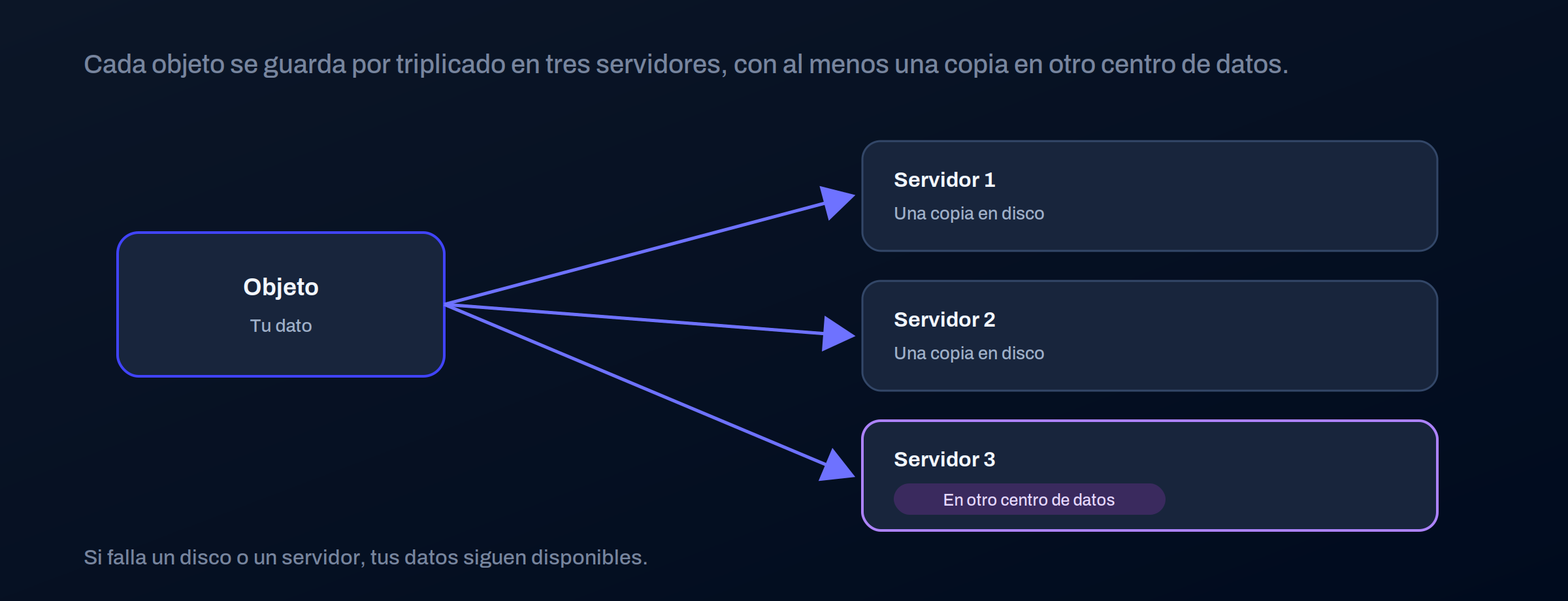
Each object is stored three times, on three disks in three different servers. If a disk or a server fails, the other copies keep the data available.
Also, by default at least one of those copies is kept in a **different data center**, so the data survives even if an entire location goes down.
> #### 📘 High durability by design
>
> Triple replication and the copy in another location are intended for very high data durability. Even so, versioning remains your best defense against deletions or overwrites, because those errors are replicated just like the good data.
### Encryption and access
| Layer | Protection |
| ---------- | ---------------------------------------------------- |
| In transit | Access to the repository is encrypted via HTTPS |
| At rest | Objects are stored encrypted |
| Access | Via S3 credentials, which you control and can rotate |
### Compliance
The service falls within the platform's certifications and regulations, designed for the different markets in which we operate.
| Framework | What it certifies | Scope |
| --------- | ---------------------------------- | -------------- |
| ISO 27001 | Information security management | International |
| ENS | National Security Framework | Spain |
| HDS | Health Data Host, health data | France |
| GDPR | General Data Protection Regulation | European Union |
### Where to go next
* How you recover previous versions: [Buckets and objects.](/docs-en/productos/object-storage/concepts/buckets-and-objects.md)
* Who and what accesses the repository: [S3 access: users and credentials.](/docs-en/productos/object-storage/concepts/s3-access-users-and-credentials.md)
---
# Agent Instructions
This documentation is published with GitBook. GitBook is the documentation platform designed so that both humans and AI agents can read, navigate, and reason over technical content effectively. Learn more at gitbook.com.
## Querying This Documentation
If you need additional information that is not directly available in this page, you can query the documentation dynamically by asking a question.
Perform an HTTP GET request on the current page URL with the `ask` query parameter, and the optional `goal` query parameter:
```
GET https://docs.plenit.com/docs-en/productos/object-storage/concepts/resilience-and-security.md?ask=&goal=
```
`ask` is the immediate question: it should be specific, self-contained, and written in natural language.
`goal` is optional and describes the broader end goal you are ultimately trying to accomplish on behalf of the user. GitBook uses it to tailor the answer towards what is most useful for that goal.
The response will contain a direct answer to the question and relevant excerpts and sources from the documentation.
Use this mechanism when the answer is not explicitly present in the current page, you need clarification or additional context, or you want to retrieve related documentation sections.